
AI search strategy: what to do and how to do it so AI mentions and cites you
Measuring is the easy part. The hard part is your team knowing, come Monday, what to write, what to optimize, and which outlet to call. We turn the diagnosis into a plan of prioritized actions, and execute it with you.
Trusted by brands that lead their market
Claude
¿freidora de aire o horno para una familia?
zapatillas trail impermeables review, top 5 de 2026
¿colágeno funciona de verdad?
- crema solar piel sensible ¿cuál?
- crema solar piel sensible cara
- crema solar piel sensible niños
¿mejor espuma limpiadora piel grasa?
¿merece la pena un colchón viscoelástico? Llevo 2 semanas dudando
You have a dashboard. You still don't know what to do on Monday
The AI search market has filled up with dashboards in eighteen months. They all say more or less the same thing: you barely show up, your competitor shows up more, and here's a chart.
After the first week of curiosity, the pattern is always the same. The team looks at the dashboard, confirms they're behind, and goes back to doing exactly what they were doing before. Because between "your share of voice is 8%" and "write this piece, optimize this URL, call this outlet" there's a gap that no tool bridges on
That gap is this service. We've also stared at pretty dashboards without knowing what to do with them, which is why we built this the other way around: action first, then the data that justifies it.
What a measurement tool gives you
What it actually takes to move the needle
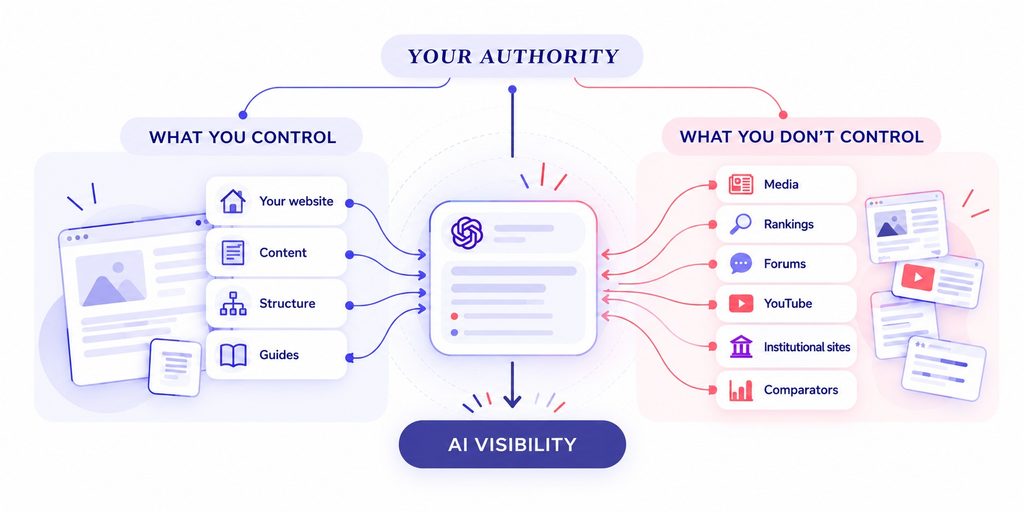
You only control half of your authority. The other half has to be worked separately
When an AI engine decides who to cite to answer a question in your category, it pulls from two places: your own content, and what third parties say about you. Most brands only work the first one, and that's exactly where they hit the ceiling.
Path 1: What you control
Your website, your architecture, your product pages, your guides. This is the path to start with, because it's the only one you can execute without asking anyone's permission, and where the return comes fastest.
If there's a topic you want to be cited for and you don't have a page covering it, or you do but it's not structured to be extracted, there's nothing for AI to cite. Before thinking about media coverage, that gap gets closed first.
Path 2: What you don't control
Media outlets, comparison sites, rankings, forums, YouTube channels, institutional pages. Today a significant share of answers is built on third-party content, which means there are territories where your content, however good it is, simply won't compete.
There, your only options are to collaborate, get featured, or pay. It's borrowed ground: you can cultivate it, but it isn't yours. The difference between doing this blindly and doing it with data is knowing exactly which domains get cited repeatedly for the questions that matter to you, and how often. That turns a "we want press coverage" conversation into a plan with names and priorities.
The real competitive advantage lies in the second path, because almost no one is working it with data. The first path is faster; the second is much harder to replicate.
How a gap becomes a concrete task
None of this comes from a consultant's gut feeling while staring at a spreadsheet. It's a process with steps, and here they are.
Which questions you're not covering
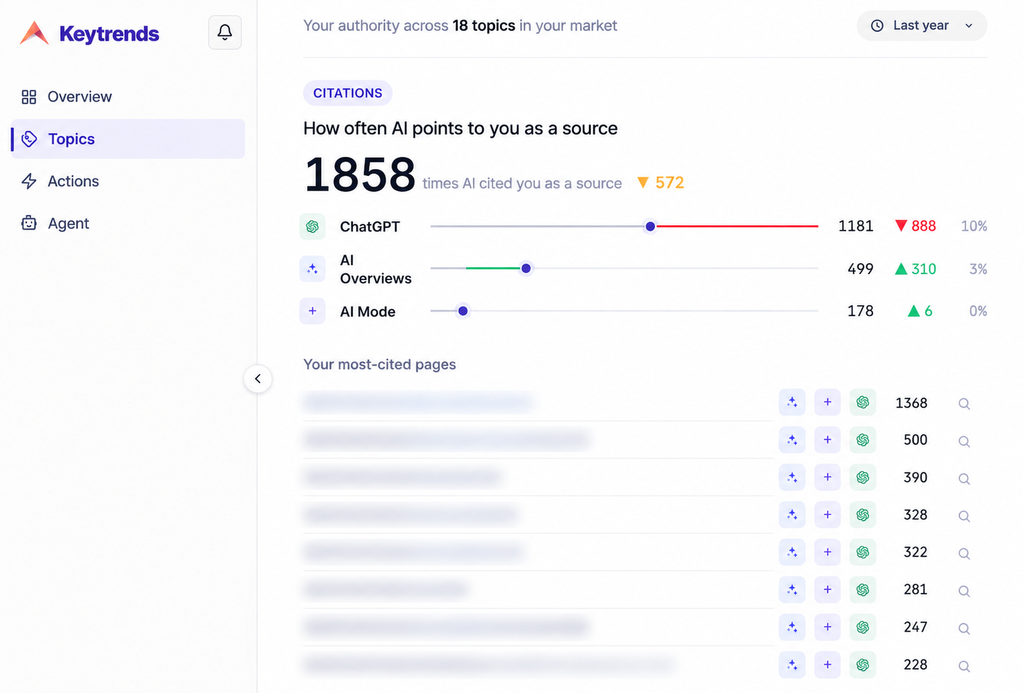
We start from measurement: hundreds of prompts per topic, tracked week by week. (How that sample is built → prompt tracking.) From there comes the list of questions where you don't show up, and which of your content should be answering them.
Who AI cites instead of you
For each of those questions, we log which domains get cited as the source. Aggregated over time, that stops being noise and becomes a pattern: for this question, AI almost always cites these three sites.
Aggregation by domain
There's a product decision here that matters. If we generated one action per URL that shows up, the system would spit out thousands of tasks that no one ever opens. We've seen projects with more than 7,000 possible actions: that's not a plan, that's a dumping ground.
That's why we aggregate by domain. If AI cites three different threads from the same forum, you don't get three tasks: you get one task about that domain, with the detail of all three threads inside for you to choose from. The action is the same; the noise disappears.
Scored by impact and effort
Every action is scored using documented numeric rules, not gut feel. You get the full criteria as an appendix, so when something is marked high impact, you can see why.
Senior review
The system proposes. A person decides. We go into this in section 6, because it's the part that sets us apart the most and the one that can't be automated yet.
Work queue
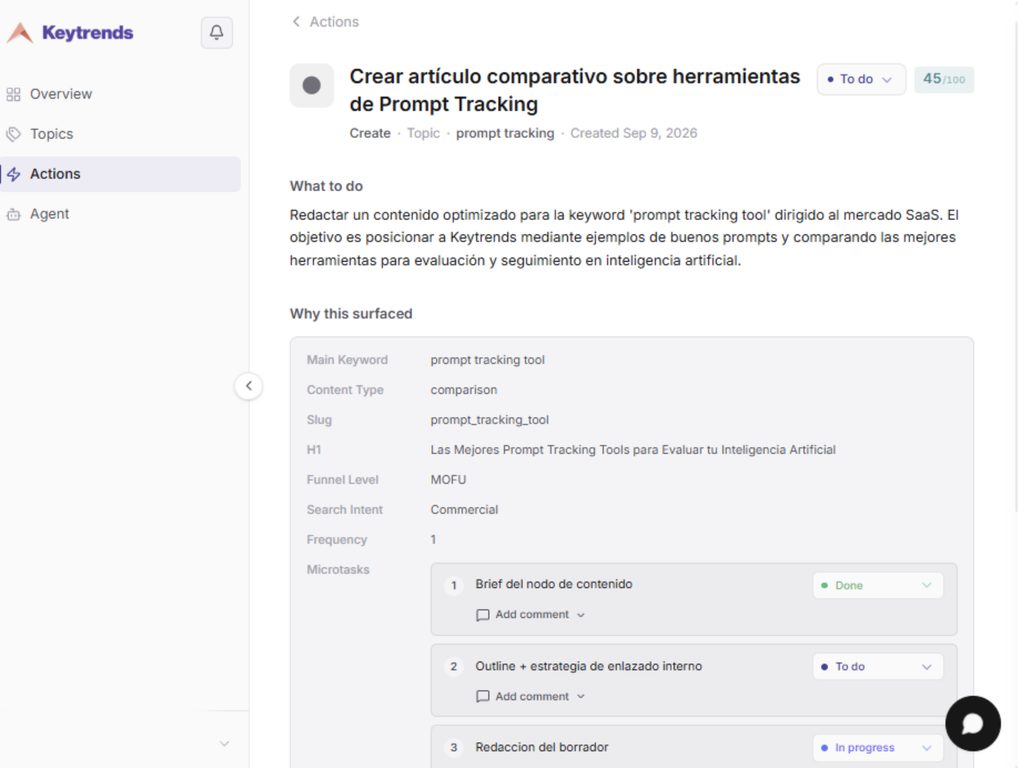
Approved actions land with your team filtered by type, by topic and by brand, with status and date. Not as a PDF, as a work queue.
Six things that need to happen, and who does them
Every action in the system falls into one of these six types. Each has a different natural owner, which is why it's worth looking at them separately before talking budgets. Actions come from the three data sources (search, AI search and social) and, if you'd rather not execute them yourselves, we do it for you with platform + consultancy, from 700 € per topic.
01 Create content New pieces for questions none of your pages answer.
There's a relevant question none of your pages answer. You need a new piece, with the right angle and format.
A brief with the real question, the related doubts, the vocabulary your customer actually uses, and the structure AI needs to extract an answer.
Your team, your agency, or us if there are no internal hands available.
02 Optimize existing content Improve pages that already exist but aren't being cited.
The page exists and covers the topic, but doesn't get cited. Usually a structure problem, not a quality one: missing the direct answer, missing the comparison table, missing the FAQ, or the topic is split across three URLs cannibalizing each other.
The specific URL, what's missing and why.
Your team, with our review.
03 Respond and participate Conversations in forums and communities where your brand isn't.
There are questions in your category that AI answers by citing forums and communities. Reddit, specialized threads, niche spaces. If the conversation lives there and your brand isn't, there's nothing to cite.
The domain, the specific threads and the recommended approach.
Community or content team, with clear guidance on how to participate without it looking like spam.
04 Reach out (digital PR) Media outlets and channels that AI cites systematically.
Media outlets, comparison sites, rankings and channels that AI systematically cites for your topic. Here the action isn't writing: it's getting featured.
The prioritized list, with how often each domain gets cited and for which questions.
Your comms team or your agencies. We give you the target and the priority; you own the relationship. Covered in more detail in section 8.
05 Brand and entities Making sure systems understand what your brand is.
Making sure systems understand what your brand is before deciding whether to cite you. Presence and consistency across Wikidata, Wikipedia, DBpedia and the knowledge bases that feed the models.
An entity check with the specific gaps.
Mixed. Some of this is solved from your own website; Wikipedia requires an accredited editor and we work with a partner for that. It's a paid service: we're telling you upfront before you ask.
06 Fix the technical layer (so AI can crawl and read it) So the bot can get in, crawl and index.
Content can be flawless and still be worthless if the bot can't get in, can't crawl, or can't index it. It's the layer nobody looks at until it breaks, and when it breaks, it invalidates everything else.
The list of issues prioritized by impact, not by volume. Each one with the affected URL or file, exactly what needs to change, and what gets unblocked by fixing it. We tell apart a one-line change (robots.txt) from something that needs development work.
Your technical or IT team, with our spec. We detect, prioritize and validate that the fix works; deployment runs on your own cycles.
Thousands of actions come out. We hand you five
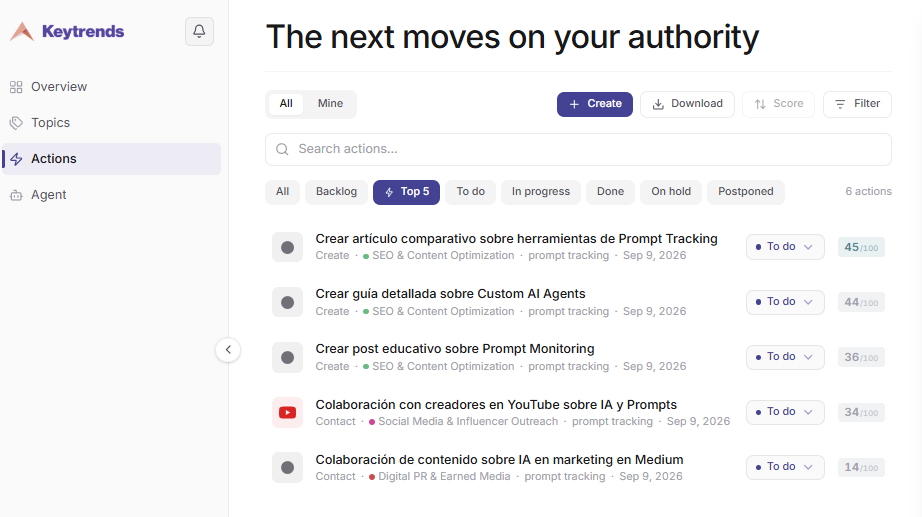
This is the point where almost the entire market fails, and where we've decided not to automate all the way.
The system can detect thousands of possible actions per topic. Technically, we could dump all of them on you with a score attached and call it done: data delivered, responsibility transferred. That's what most platforms do, and it's why almost nobody keeps using them past the second month.
We do the opposite. The system scores, and then a senior consultant discards. Of everything the machine proposes, around 10% survives: what will actually move the needle in your context, with your team and your real capacity to execute. That filter is a conversation with you, not a unilateral decision.
It's the most expensive part to deliver, and the cheapest to automate badly. We'd rather keep it this way.
We'd rather you do five well-chosen things than fifty half-done ones. And we'd rather tell you that upfront, even if it sounds like less product delivered, because noise is what kills adoption of these systems.
Automated audits, human judgment
What's repeatable is automated. Audit checklists are deterministic and run as workflows: what to measure, in what order, with what threshold. That frees the senior team from the mechanical part so they can focus on the one thing that isn't mechanical: prioritizing.
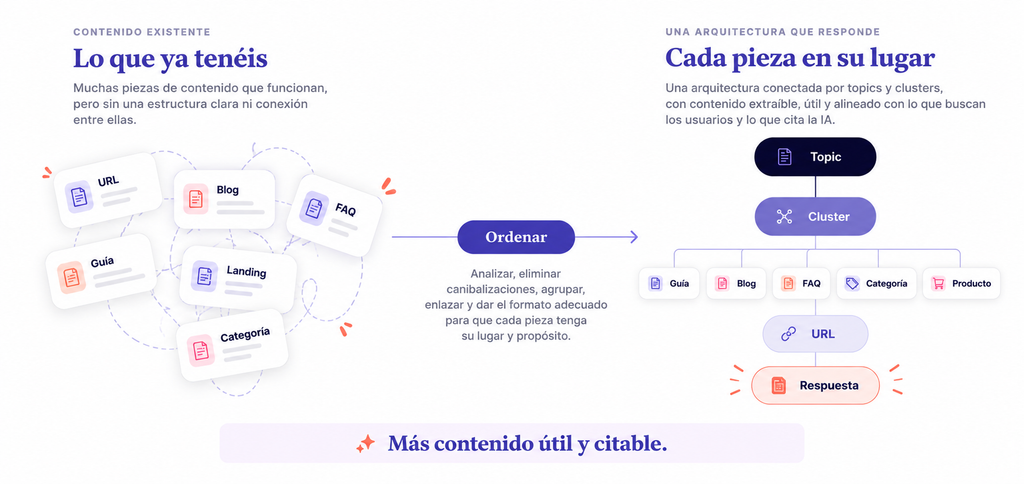
Before creating anything new, put what you already have in order
In almost every project, a big part of the problem isn't a lack of content. It's content in the wrong place.
Ideal architecture
We map your site against the topics you want to own and define where each thing should live: what goes on a landing page, what goes in a category, what in the blog, what in a product FAQ. A topic can be perfectly written and still fail to rank or get cited simply because it's in the wrong place.
Cannibalization cleanup
When three URLs compete for the same queries, none of them wins. We hand you the list of detected cannibalizations and how we recommend resolving them, so you can decide with the internal context only you have. The cleaner the clusters, the better everything injected afterward performs.
Clusters and internal linking
Every new piece goes in connected: linked from wherever it makes sense, pointing toward catalog or conversion, never left orphaned.
Formatted to be extracted
Direct answer up top, comparison tables, lists, FAQ and blocks (chunks) the AI can extract on their own. It's not cosmetic: it's the difference between a model being able to cite you versus citing the competitor who put in the table. And details that get overlooked, like PDF content that can rank yet disappear entirely from your analytics.
Data-driven briefs
Nobody writes blind. Every brief comes from what people actually ask, in what words and in what context, instead of a generic title that produces a piece that answers no one.
Production, if needed
If you don't have an internal team, we deliver content ready to publish. It's not the starting point we recommend, but it's the option when the alternative is the plan not getting executed at all.
Which sources you need to appear in, and when it's time to pay
This is the most uncomfortable section and the most valuable one, so no beating around the bush.
There are questions in your category that today get answered by citing a newspaper, a comparison site, or a YouTube channel. On those questions, your content isn't going to win in the short term, however good it is. The only option is to show up in those sources.
What we do is hand you the map: which domains get cited repeatedly for the questions that matter to you, how often, and for which specific questions. With that on the table, the conversation changes. It stops being "we should probably do more PR" and becomes "these five outlets show up in 60% of the answers for our most profitable topic; let's start there".
How it works
We don't replace your comms team or your agencies. We deliver the prioritized target and sit down with whoever owns that relationship to decide the how. Some clients hand these actions straight to their comms team, who already has media relationships. Others need us to help them find the channel.
The money question
Let's be direct about it: part of this is earned through collaboration, and part of it is bought. Wikipedia requires an accredited editor. Some outlets run on monthly fees. And not everything is worth it.
What we do is put the data in front of you and decide together: this gets cited a lot and is worth the investment, this gets cited rarely and isn't. Without the data, that decision gets made on gut feeling and existing relationships, which is how it's always been done, and that's how it's gone for all of us, ourselves included, whenever we've done it blind.
Differentiation
And there's an interesting consequence: since almost no brand is working this layer with data, whoever works it now gains an edge that isn't easy to copy.
A work queue, not another platform nobody opens
The most common objection, and the most reasonable one, is that this ends up being just another tool people open twice and abandon. Here's how we avoid that.
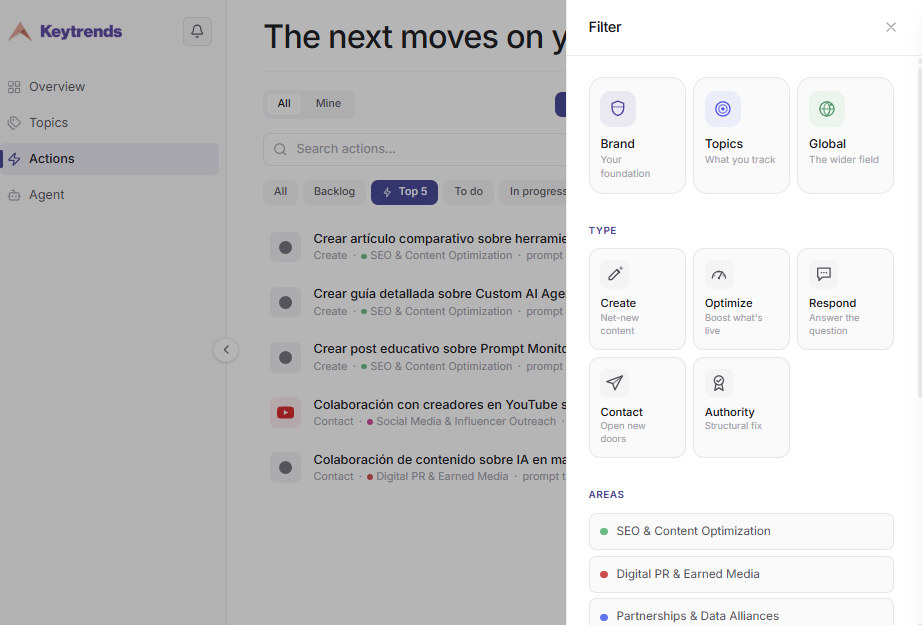
Filtered inbox
Actions arrive filterable by topic, by type and by brand. Each person sees only what's theirs. Nobody faces a list of a thousand tasks with no context.
Status and flow
Tasks get marked complete with a date. Whether your team works in kanban, on its own board, or in SharePoint, we fit into that flow instead of asking you to change yours.
Your own tasks count too
If you do something that wasn't in our plan, an outlet deal that comes up, a piece you decide to publish, it can be logged the same way and its impact measured.
Every action executed, against the curve
This whole section has one precondition: you have to tag what you do. If you publish a piece and we don't know which URL it is, there's no way to measure its impact.
URL tagging
URLs created or optimized within the plan carry an identifier. With that, everything worked on gets segmented and reported separately. With clients we use our own URL tag, but it can be whatever convention you already have.
Task annotations on the series
Every completed task gets annotated on the authority curve, just like Search Console annotations. Don't expect a clean correlation: in authority work, there isn't one. A migration or a misconfigured robots.txt causes an immediate drop, but a content improvement takes time and shows up diffuse. What you can actually see, and what we're looking for, is the trend.
The reading that matters
If you execute and the curve goes up, it's working. If you execute and it doesn't go up, there's a second reading that's also information: the competition is moving faster than you are.
Actions taken and what happened next
Testimonials

“Keytrends fills a very important gap in the SEO sector: real-time tracking of search trends. Thanks to Keytrends we have been able to automate the detection of organic opportunities and be much more agile when it comes to covering them.”
“KeyTrends allows you to monitor the real-time evolution of search trends to optimise your content in just a few minutes.”
“Word of mouth has always been our main source of sales, but with Keytrends we have managed to grow in organic traffic, obtain new leads and position ourselves as a reference.”
Frequently Asked Questions
We already have an agency and an SEO team. Does this replace them?
No, and we don't want to. What we do is give you a map and an order of priorities: what to tackle first, what to update now, what to ignore. A good team without that map spends half its time guessing. With it, they get twice the output for the same effort.
We publish a lot of content and see no return. Why would this change that?
Because publishing without a plan is sowing on asphalt. The problem is almost never volume: it's that the pieces don't answer questions anyone actually asks, they're not where they should be, and they're not connected to each other or to the catalog. The system links every piece to a concrete chain: real question, piece, indexing, cluster, sale.
We don't have a team to produce more content.
You don't need to grow headcount. The heavy lifting, spotting topics, researching them and turning them into briefs, is automated. What's left for your team is only the critical part. And if there are no internal hands, we deliver content ready to publish.
We don't have extra budget this year.
Then this isn't an added expense, it's a reallocation decision. With the same budget and the same team, the difference is publishing ten pieces chosen with data instead of thirty chosen on gut feeling. What changes isn't how much you spend: it's on what.
We operate in several countries. Does this multiply per market?
Not linearly. The worst thing you can do is clone the same content everywhere. What we do instead is identify in which markets the topic is searched and asked about differently, and adapt only those. That reduces work instead of multiplying it.
Isn't this just regular SEO with a different name?
It shares fundamentals but splits off in two ways. First, the goal: you're no longer chasing a click, you're chasing being the source that gets cited. That changes the content format and changes what counts as success. Second, the weight of third parties: in classic SEO you could build almost everything from your own domain; in AI search, part of the answer gets built outside your website, and that has to be worked on explicitly.
How long until we see results?
We're not going to give you a magic number, and if anyone else does, be skeptical, it depends on the topic, your starting point, and how fast you execute. What we can commit to is that within a few weeks of starting to measure, you'll have a time series and a prioritized plan, and that URL tagging lets you see the evolution of everything you publish from day one.
Do we have to pay media outlets for this to work?
Not to get started. The first phase is your content and your architecture, which is what you control and what returns fastest. The conversation about third parties comes later, with real data on which domains actually get cited in front of you, and it's decided case by case.
Start by knowing which topics you can win
The first session isn't a product demo. It's looking at your topics together, seeing where you have real room to win and where it's not worth fighting, and walking away with a short list of things to do.
Pick a day and time in our calendar. Opens in a new tab.