
The 10 best tools for measuring visibility in AI search
Tabla de Contenidos
A complete guide to the best tools for measuring AI visibility in 2026, so brands can stop guessing and start building real authority in AI-generated search results.
AI visibility measurement tools analyze how ChatGPT, Gemini, Claude, Perplexity, and other systems cite, describe, and recommend your brand.
Visibility in AI-generated answers is already as decisive as traditional Google rankings: if you are not the source, you are noise.
Measuring is not enough. Brands that win combine authority data, topic-based strategy, and content execution, not just a pretty dashboard.
Keytrends stands out because it goes beyond "do you appear or not?": it reveals why you do not appear and maps out the path, topic by topic, so AI cites you first.
Keytrends offers three ways to work: the self-service GEO platform for SEO teams, the platform with consulting to work on specific topics (for example, sunscreens) with Keytrends handling execution, and boutique SEO and GEO consulting for large brands.
What Are AI Visibility Measurement Tools?
AI visibility measurement tools help brands understand how large language models such as ChatGPT, Gemini, Claude, and Perplexity represent them in AI-generated answers.
They measure:
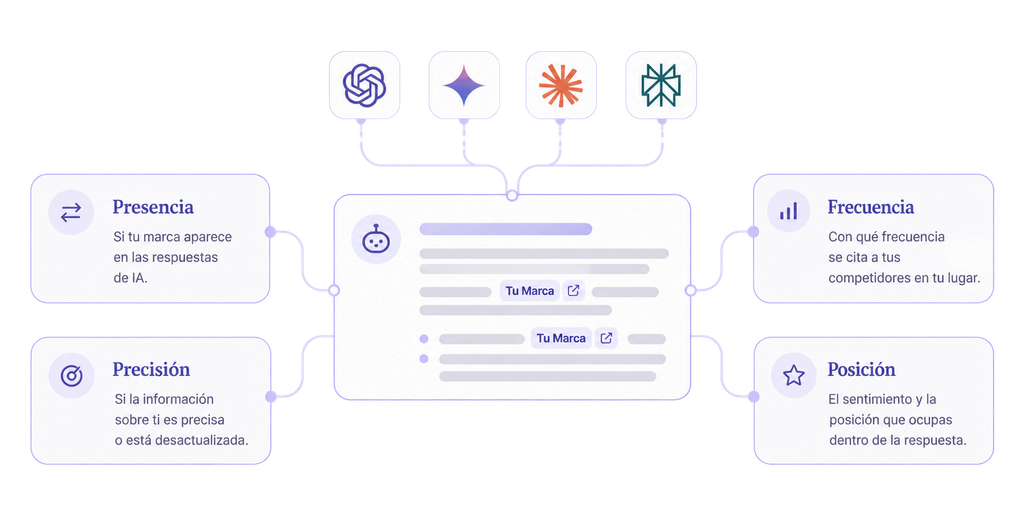
Unlike traditional SEO, which focuses on page rankings, these platforms operate at the answer level: it is not only about whether your website ranks, but whether AI decides to cite you when answering a user.
Why Does AI Visibility Matter?
Search behavior has changed: users are asking AI, not just Google.
This creates a new layer of visibility where:
- You can rank well on Google and still not appear in AI-generated answers.
- AI systems shape user perception before they click on any link.
- Being cited becomes the most important trust signal in the funnel.
Brands that monitor and optimize their AI visibility today gain an advantage in awareness, recommendation, and conversion tomorrow.
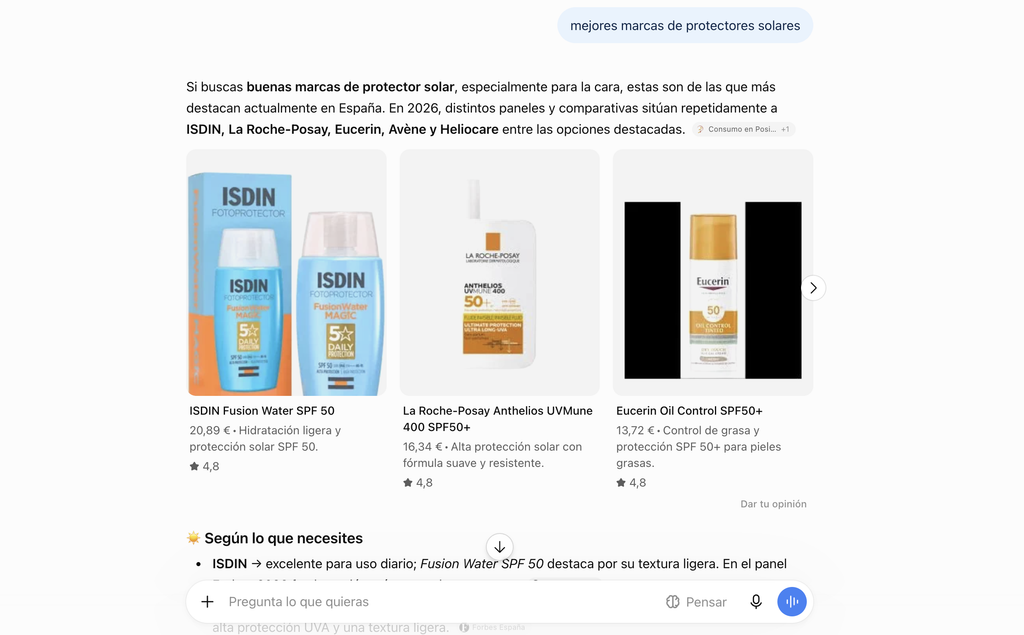
Here we can see an example of a search for the best sunscreen brands in ChatGPT, which returns a list of brands. This is what we mean when we talk about being cited in AI-generated answers.
Discover how we helped Promofarma multiply its Google Discover visibility by 25x →
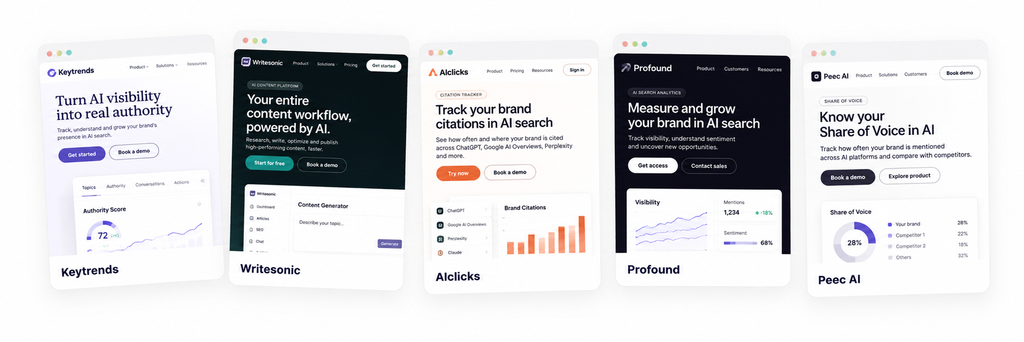
The 10 Best Tools to Measure AI Visibility in 2026
Keytrends, The Platform That Turns AI Visibility into Real Authority
Keytrends starts from a different premise than the rest of this list: AI visibility is not a matter of luck or a ranking to be chased keyword by keyword. It is topical authority that is built, measured, and defended, topic by topic and category by category.
While most tools answer "are you visible?", Keytrends answers "why aren't you visible, and what are you going to do about it?". That is the leap from a monitoring dashboard to a decision-making and execution system.
Key features
- KTA™ Authority: measure your authority against the competition: a proprietary system that combines your position in Search and AI Search to understand who leads each topic and where you are gaining or losing authority. It does not just tell you how much traffic you have: it shows which brands are leading the conversations that actually move your business.
- AI Search & Share of AI Voice: monitors your brand's presence in the generative answers of the leading AI engines and measures how often you appear and are cited compared with your competitors. Measurement is organized by topics and conversations to identify exactly where you are present and where you are not.
- Conversations and competition by topic: analyzes the questions and searches relevant to each business area and shows which brands, domains, and sources are occupying those conversations. You can compare the reality of Google Search with AI Search and identify when the brands dominating organic results are not the same ones dominating AI answers.
- Actions: turn data into an execution plan: identifies what you need to do to build authority: what content to create, which URLs to optimize, which conversations to work on, and which sources or communities you need to appear in. The goal is not to give you another dashboard, but to turn every gap into a prioritized action.
- AI Agents: specialized agents that help turn Keytrends data into executable work, from analysis and content to technical aspects and citations. The current platform includes agents such as editorial agent, technical agent, and citations agent.
- Content Gaps and topical architecture: identifies which relevant topics and searches you are covering and which ones you are still missing, organizing them into clusters to complete your strategy, avoid cannibalization, and build topical authority.
- Data Hub & Content Matrix: combines available trend, keyword, entity, and content data to turn research into an actionable content strategy, including evergreen opportunities, trends, and existing content optimization.
- Keyword, Entity & Trend Research: discovers what your audience is searching for, which entities are related to each topic, and which trends are growing, using data from multiple sources. Keytrends supports both evergreen strategies and real-time opportunities.
- AI Content Assistant: researches search intent, analyzes competitors, and generates briefs or complete content with AI based on search data. It also allows you to work on existing content and adapt the research before generating the text.
- Google Profile & Brand Authority: free tools to discover how Google understands your brand as an entity, which connections it establishes in its Knowledge Graph, and how your brand relates to competitors and other entities in the digital ecosystem.
How you can work with Keytrends
This is something that sets Keytrends apart from the rest of this list: it is not just software.
- Self-service GEO platform: full access to the platform (Authority Score, AIO Research, Content Gaps, content generation, citations, share of voice and brand sentiment, with data from search, AI search and social media) for teams that want to manage their own AI authority strategy.
- Platform + consulting: Keytrends senior consultants, managers and agents prioritize the 10% of actions that drive 80% of the result and execute them on specific topics (for example, sunscreens), even if you already work with another agency.
- Boutique SEO and GEO consulting: without SEO there is no GEO. We operate the Keytrends platform and strategy for you: we monitor every channel where your customer makes decisions, measure who leads each conversation, and bring you a prioritized action plan every week. There is no dashboard you need to learn how to read; we read it for you.
Why it stands out
- It is built specifically around the concept of cumulative topical authority: every topic you win strengthens the next ones, instead of treating each keyword as an isolated event.
- Combines in a single system what other tools separate: AI monitoring, competitor benchmarking, content gaps, and real content execution, without needing to connect three or four different tools.
- It has documented use cases with real brands (FNAC, PromoFarma, PcComponentes, among others), providing traceability around results, something that is scarce in such a new category.
- It offers free entry tools (Google Profile Tool, Free Brand Authority Tool) so any brand can see where it stands before committing.
Things to consider
- Its DNA comes from ecommerce and SEO content marketing, so teams looking exclusively for a pure LLM mention monitoring tool, without any strategy or execution component, may find the offering broader than they initially need.
Writesonic, End-to-End GEO + LLM Visibility Tracking Platform
Writesonic positions itself as a complete Generative Engine Optimization (GEO) platform.
Key capabilities
- Tracks visibility across ChatGPT, Gemini, Claude, Perplexity, and more.
- Includes analysis of traffic coming from AI.
- Provides optimization recommendations.
- Integrates SEO and content generation tools.
Strength: combines tracking with execution guidance, going beyond a simple dashboard.
Limitation: remains focused on its own product ecosystem, making it less flexible for complex enterprise data pipelines.
AIclicks, Visibility Tracking + Content Execution
AIclicks combines visibility tracking with automated content execution.
Key features
- Tracks citations and mentions across AI engines.
- Competitor benchmarking.
- Automated content creation to close identified gaps.
- Weekly optimization recommendations.
Best for: SEO teams that need both insights and automated content workflows within the same tool.
Profound, LLM Monitoring and Prompt Intelligence
Profound is a monitoring-focused platform with very broad data coverage.
Key features
- Visibility tracking across more than 10 AI engines.
- Conversation explorer with a prompt dataset of more than 400 million prompts.
- Sentiment and share-of-voice tracking.
- Analysis of AI agents and crawlers.
Strength: hard-to-match insights into real user prompt behavior.
Limitation: its optimization and execution capabilities are limited; it often requires external tools to turn data into action.
Peec AI, Lightweight AI Visibility Tracker
Peec AI focuses on simplicity.
Capabilities
- Citation and mention tracking.
- Sentiment analysis.
- Competitor comparisons.
- Clean and straightforward dashboard interface.
Best for: startups or teams that need quick, frictionless visibility insights.
Limitation: its execution and optimization features are minimal; it is primarily a visibility thermometer.
Scrunch AI, Persona-Based AI Monitoring
Scrunch AI provides visibility analysis driven by user profiles (personas).
Key features
- Tracks brand visibility across multiple AI platforms.
- Segments prompts by user persona.
- Includes AI crawler analysis.
- Offers an Agent Experience Platform (AXP).
Strength: helps you understand who the AI responses mentioning (or not mentioning) your brand are actually targeting.
Limitation: its content optimization capabilities are limited compared with tools that are more focused on execution.
AthenaHQ, Multi-Region GEO Visibility Platform
AthenaHQ specializes in regional AI visibility reporting.
Capabilities
- Multi-country tracking.
- Industry-specific insights.
- Machine learning-based prompt estimation.
- Competitor benchmarking.
Best for: global brands operating across multiple markets that need to compare their visibility country by country.
Otterly AI, Affordable LLM Tracking Tool
Otterly AI is built to be accessible from day one.
Features
- Tracks AI mentions and citations.
- Simple, easy-to-read dashboards.
- Quick setup.
Strength: low barrier to entry for teams just starting to monitor their AI visibility.
Limitation: limited analytical depth and advanced features compared to more comprehensive platforms.
Nightwatch, Hybrid SEO + LLM Tracking Tool
Nightwatch combines traditional SEO and AI tracking in a single tool.
Capabilities
- Keyword ranking tracking + AI visibility tracking.
- SERP feature monitoring.
- Global and local tracking.
- Automated reporting.
Strength: combines traditional SEO with emerging GEO tracking in a single workflow, useful for teams that do not want to duplicate tools.
AirOps, LLM Tracking + Content Workflow Automation
AirOps focuses on scaling content operations using visibility data.
Key features
- AI-powered content workflows.
- CMS integrations.
- Workflow automation.
- Content production directly linked to AI visibility.
Strength: powerful for teams managing content production at scale and needing to connect that volume with citation data.
Limitation: more complex setup and a steeper learning curve than lighter tracking tools.
Comparison Table: AI Visibility Measurement Tools
| Tool | AI Models Covered | Competitor Analysis | Content Gap Detection | Content Execution / Generation | Expert Team Support |
|---|---|---|---|---|---|
| Keytrends | ChatGPT, Gemini, Claude, Perplexity, AI Overviews | Authority Score/Index + competitor entities | Automated Content Gaps | KT Agents + content assistant | Strategic or niche-specific support with a team (optional) |
| Writesonic | ChatGPT, Gemini, Claude, Perplexity | (built into its ecosystem) | |||
| AIclicks | Major AI engines | (automated) | |||
| Profound | 10+ AI engines | (sentiment and share of voice) | Limited | (requires external tools) | |
| Peec AI | Major AI engines | ||||
| Scrunch AI | Multiple AI platforms | (by user persona) | Limited | ||
| AthenaHQ | AI engines, multi-region | By industry | |||
| Otterly AI | Major AI engines | Basic | |||
| Nightwatch | SEO + AI engines | Limited | |||
| AirOps | AI engines | Limited | (content pipelines) |
Covered · Partial or limited · Not available or requires external tools
What to Look for in an AI Visibility Measurement Tool
Choosing the right tool depends on five factors:
Multi-model coverage
It should track ChatGPT, Gemini, Claude, Perplexity, etc., not just one.
Citations vs. mentions
Citations indicate real trust; mentions alone say very little.
Prompt-level insights
Understanding how related queries vary is key to avoiding a focus on a single keyword.
Competitor benchmarking
Visibility only makes sense in context, compared with who is winning the topic.
Actionability
The data should translate into a concrete next action, rather than remaining a nice-looking number on a dashboard.
This last point is precisely where platforms like Keytrends, which combine measurement with strategy and execution, as well as support, stand out from tools that stop at monitoring.
Do AI visibility measurement tools replace SEO tools?
Short answer: no, they complement them.
- SEO tools track rankings and traffic.
- AI visibility measurement tools track citations and brand perception within AI-generated answers.
- Modern strategies need both layers working together, rather than one replacing the other.
This is precisely why approaches such as Keytrends' consulting make sense: they do not require a brand to break away from its current agency, but instead add an AI authority layer focused on the content niche that actually drives the business.
Frequently Asked Questions
What are AI visibility measurement tools?
They are platforms that monitor how your brand appears in responses generated by LLMs in systems such as ChatGPT, Gemini, Claude, or Perplexity.
Why do AI visibility measurement tools matter?
Because they reveal whether your brand is cited, recommended, or simply ignored in AI-generated answers, a layer of visibility that already influences user decisions before they visit your website.
Can these tools improve my rankings?
Indirectly: they identify content gaps and insights that, when properly executed, guide positioning strategies in both search engines and AI.
What is the best tool for measuring AI visibility?
It depends on your objective: if you only need a lightweight monitoring tool, there are affordable options on this list. If you want to understand why you are not appearing and build a topic-by-topic authority plan, with or without support from an expert team, Keytrends is the most comprehensive option.
AI Visibility Tools Represent a Fundamental Shift in Search Visibility
As users move from clicking links to consuming AI-generated answers directly, brands need to understand not just where they rank, but how they're represented, cited and compared within these systems.
The most effective strategies go beyond monitoring: they combine visibility, topical authority and structured execution. That's exactly the ground Keytrends has built its offering on: revealing your real authority, topic by topic, and mapping the path so that when AI decides who to cite, that brand is you.