
Google’s UCP: what the Universal Commerce Protocol is and how it powers Agentic Commerce
The Universal Commerce Protocol (UCP) is an open standard that acts as a “common language”, or the “HTTP of commerce”, for the AI era. Its role is to enable AI agents (such as Gemini) to understand and operate across any online store, carrying out tasks autonomously: from discovering products and negotiating discounts to completing payment and managing shipping, all without the merchant having to build a separate integration for each platform.
by
Context
In the vibrant world of digital commerce, the term Agentic Commerce is gaining momentum, and Google has positioned itself as a pioneer with the launch of the Universal Commerce Protocol (UCP). Agentic Commerce is when AI agents complete purchases autonomously on behalf of users. In this model, the agent doesn’t just act as a recommender, but as the gatekeeper of the transaction, taking the authority to buy once it has received human approval.
UCP is not a closed platform, but an open standard protocol designed to establish a common language between AI agents and commerce systems. This effort has been co-developed with leaders such as Shopify, Walmart, Etsy, Target and Wayfair, enabling any AI surface (such as Gemini or Search’s AI Mode) to orchestrate end-to-end shopping journeys.
The protocol is already starting to appear gradually across English-speaking e-commerce sites, and in Spain it’s expected to arrive soon. The key point is that if you run an international or multi-country e-commerce business, you should keep an eye on it so you can put a strategy in place from day one, even if most of your sales currently come from Spain.
What changes in eCommerce when agents can buy on the user’s behalf?
The Commerce Communication Layer
UCP works like the “HTTP of AI-powered commerce.” By using standards such as REST, JSON-RPC, and the Model Context Protocol (MCP), it allows agents to discover merchants and understand their capabilities without requiring custom integrations for each platform. This interoperability is what enables the shift from simple search to task execution.
The Business Agent and the New Personalisation
Personalisation is evolving through the Business Agent, a brand AI assistant that acts like a virtual sales associate directly within Google Search. To power this experience, retailers now use new data attributes in Merchant Center that go beyond keywords, including FAQ answers, compatible accessories, and detailed use-case scenarios.
In addition, through OAuth 2.0, the protocol enables Identity Linking, allowing agents to maintain secure, authorised relationships with users in order to manage loyalty programmes and previous preferences without exposing sensitive credentials.
Where will the purchase happen: Search, Gemini, voice, or chat?
UCP enables a surface-agnostic experience, allowing consumers to interact seamlessly via voice, chat, or visual interfaces. This omnipresence makes it possible to capture demand through disruptive tools:
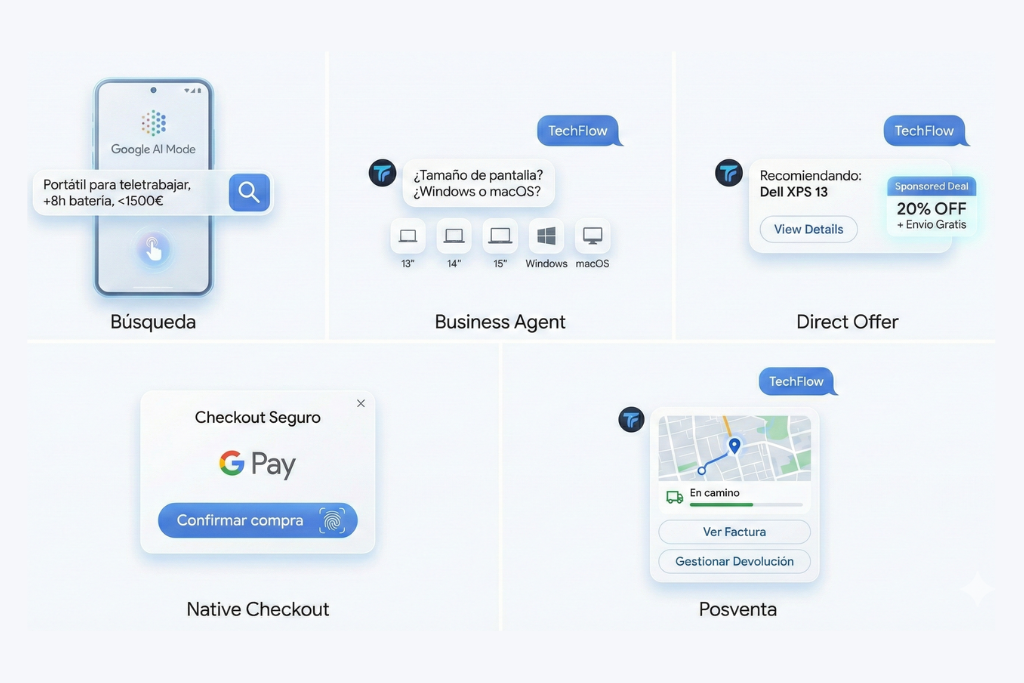
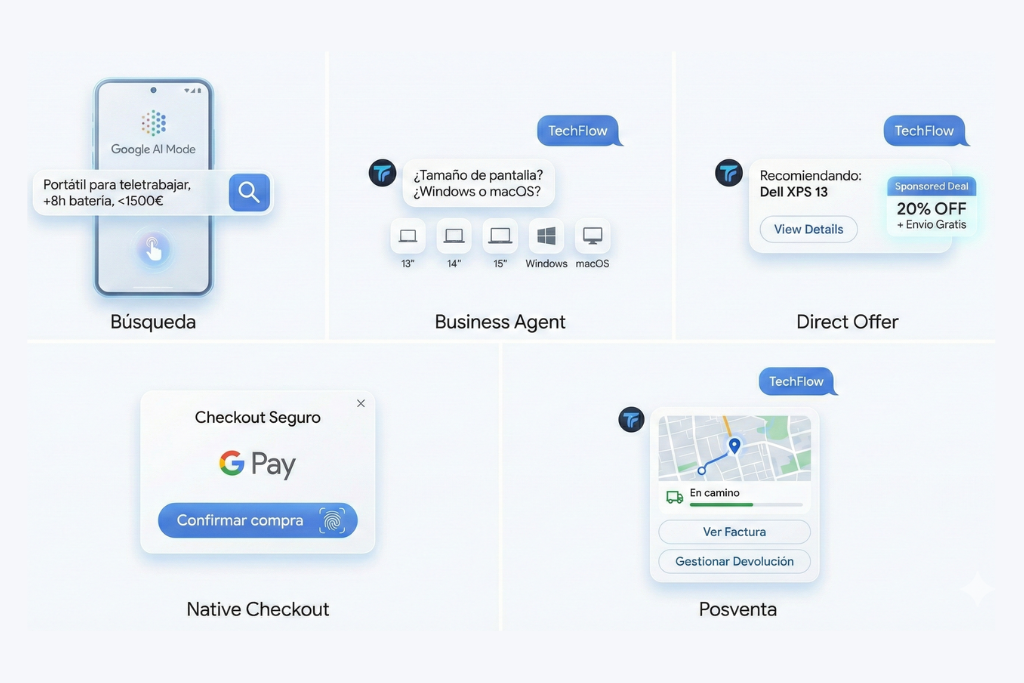
- Direct Offers: A Google Ads pilot that lets you surface exclusive discounts and promotions (such as bundles or free shipping) right when the AI detects the user is ready to buy.
- Native Checkout: Users can complete purchases without leaving the AI interface, using saved payment and shipping details in Google Pay.
It’s vital to emphasise that the retailer always remains the Merchant of Record, retaining full control over its pricing, business rules, and ownership of customer data.
Example: A UCP shopping journey (from search to after sales)
- A user asks in AI Mode (Search’s AI Mode): “I want a laptop for remote work with at least 8 hours of battery life for under €1,500.” Instead of sending them a list of links, the flow becomes a purchase-oriented conversation.
- The brand’s (or retailer’s) Business Agent asks 2–3 quick questions to narrow down the choice: What screen size (13/14/16)? Do you prefer Windows or macOS? Do you prioritise performance (video calls + multitasking) or mobility? Based on the answers, it recommends a few options that fit the budget and explains the “why” using clear criteria: real-world battery life, weight, webcam/mic quality, connectivity, warranty, and delivery lead times.
- If the system detects high intent, it can surface an offer (for example, free shipping, a bundle discount with a dock/mouse, or a limited-time voucher). Once the user confirms their choice, the purchase is completed via native checkout without leaving the interface, using a saved payment method (for example, Google Pay).
- After the purchase, the same thread supports after-sales: checking order status, tracking delivery, resolving invoice or warranty queries, and if needed, starting a return or exchange without having to jump to external forms.
Why does Merchant Trust shift from a ‘signal’ to a technical requirement?
Implementing UCP streamlines operations by removing the need to build individual connections for each agent. However, it also introduces the technical requirement of Merchant Trust. For an agent to decide to transact, the merchant must provide a stable identity, consistent data, and predictable compliance policies.
What is ACO, and what should an e-commerce business do to sell in AI-driven flows?
For your e-commerce business to be compatible with this protocol and discoverable by AI agents, it’s essential to make a strategic shift towards ACO (Agentic Commerce Optimisation). This approach expands beyond traditional SEO by focusing on enabling transactions rather than simply ranking pages. According to the sources, the critical steps are:
Merchant Center setup
This remains the foundational pillar, but it now requires more precise data. It’s essential to clearly define return policies, technical support information, and indicate eligibility for agentic checkout.
Conversational Commerce Attributes
Google has introduced new attributes designed for AI-driven discovery. You should update your feeds to include product FAQ answers, identify compatible accessories, suggest substitutes, and describe detailed use-case scenarios. A fully enriched feed is what will give you the edge over your competitors.
Structured Data Synchronisation (Schema.org)
Site structured data has always been important, but now that your potential customer is an AI agent, it becomes critical. AI agents rely heavily on on-site data markup (price, availability, reviews, and shipping). Any inconsistency between your website and your Merchant Center feed is treated as a trust risk that can prevent the agent from completing a transaction. Under this new standard, elements like Schema.org markup become the “glue” that enables agents to discover and trust a merchant.
Publishing the JSON Manifest
Para permitir el descubrimiento dinámico, los comercios deben publicar un manifiesto en la ruta del servidor /.well-known/ucp. Este archivo lista las capacidades del comercio, sus servicios disponibles y los puntos de conexión (endpoints) para que la IA sepa exactamente qué puede y qué no puede hacer el negocio sin necesidad de integraciones personalizadas.
Facilidades de Pago y el Estatus de “Merchant of Record”
UCP revolutionises the checkout process by introducing a native checkout experience within surfaces such as Gemini and Search’s AI Mode. This enables shoppers to complete purchases securely using the payment and delivery details saved in their Google Wallet (with initial support for Google Pay, and PayPal coming soon).
At a technical level, this security is underpinned by the Agent Payments Protocol (AP2), which ensures that every transaction is backed by cryptographic proof of the user’s consent. A crucial point for businesses is that, despite AI mediation, retailers always remain the Merchant of Record. This means the business retains full ownership of customer data, control over its commercial rules (such as pricing and discounts), and the direct after-sales relationship.
What changes after the purchase: orders, tracking, and returns within AI?
The user experience in the UCP ecosystem becomes surface-agnostic, operating seamlessly across any modality (chat, voice, or visual). This is reflected in two key tools highlighted in the sources:
- Business Agent: A brand-identified AI assistant that acts like a virtual sales associate. This agent can be trained on the retailer’s data to answer questions in the brand’s own voice and guide the user towards a direct purchase.
- Order Management and Support: The protocol doesn’t end at the sale; it includes order management capabilities that enable order tracking, real-time status updates via webhooks, and returns processing.
The Future of Commerce: Open Ecosystems and Collaboration
The future of e-commerce, according to the sources, is moving towards an open collaboration model to avoid fragmentation. UCP has been co-developed with giants such as Shopify, Etsy, Walmart, Target and Wayfair, and is backed by payment networks and providers including Visa, Mastercard, Stripe, Adyen and PayPal.
Conclusion
The agentic commerce era will require success to be measured no longer solely by traditional web traffic, which may decline as transactions take place within AI interfaces. The brands that will thrive are those that build Merchant Trust through a stable identity and consistent data, enabling AI agents to trust them to purchase on humans’ behalf.
In this new paradigm, optimising for agents means moving away from “renting” fleeting clicks and instead building an enduring authority asset that secures lasting relevance where business is actually closed.